233 years ago some brave and noble people drafted the preamble to The Declaration of Independence.
It's worth a read if you haven't seen it lately:
"When in the Course of human events, it becomes necessary for one people to dissolve the political bands which have connected them with another, and to assume among the powers of the earth, the separate and equal station to which the Laws of Nature and of Nature's God entitle them, a decent respect to the opinions of mankind requires that they should declare the causes which impel them to the separation.We hold these truths to be self-evident, that all men are created equal, that they are endowed by their Creator with certain unalienable Rights, that among these are Life, Liberty and the pursuit of Happiness. That to secure these rights, Governments are instituted among Men, deriving their just powers from the consent of the governed, That whenever any Form of Government becomes destructive of these ends, it is the Right of the People to alter or to abolish it, and to institute new Government, laying its foundation on such principles and organizing its powers in such form, as to them shall seem most likely to effect their Safety and Happiness."
Have a wonderful Independence Day !
Tuesday, June 30, 2009


Tuesday, June 23, 2009
Infinity Tower II almost 50% sold in 5 months. Hmmmmmm...
Through a combination of pent-up demand, attractive interest rates and significant seller discounts, The Infinity Tower II has approximately 140 out of 285 units currently in contract or closed since sales began in early February.
This astounding number of sales is not so surprising when you look at the fundamentals of the Downtown market. Achieving a great price in this environment is still possible, you just need to know the music so you can dance along and always keep your eye on the goal.
1.) Competition ? What competition ?
For those that want new, high rise and downtown, there are four choices: BLU, Millennium, One RIncon and Infinity. All are very nice buildings. Out of these four The Infinity seems to have the combination of amenities, views, location and value that are driving sales numbers that I didn't see in new construction even at the height of the bubble.
2.) V is for Value.
In an uncertain market it takes a compelling argument for buyers to pony-up the dough. That, and a motivated seller. Although buyers and their agents must sign confidentiality agreements regarding the details of their contracts, I can say that the discounts being offered at most sales offices right now are dramatic but not fire sale.
This may sound lame but it bears repeating: This is San Francisco. Buyers need to go through several rounds of offers before striking a deal.
3.) Reality Bites.
Sometimes buyers judgement gets a little cloudy which is no surprise given the emotional nature of purchasing a home. The most important thing to remember during negotiations is to keep your cool and try to put yourself in the seller' shoes. Even though they may be a faceless, corporate behemoth you are still working with a human. One that most likely has to report to another human. That, and this development is his or her baby. When you submit a low-ball offer don't be surprised with a high counter. You've just started to dance so don't get discouraged or angry, hang in there.
If The Infinity can keep it's current weekly absorption numbers going, they will be sold out by the end of the year. I don't think that's their goal, though. At half sold they have achieved an enviable velocity that can be slowed, if they so desire, to try to achieve higher prices on their remaining inventory. That may seem foolish given continuing economic uncertainty but don't believe you know what the seller is thinking.
Ask me and I'll tell you.
Tuesday, June 16, 2009
The Skinny on Short Sales
Just the mind-splitting hangover some people wake up with after over indulging, some folks these days are coming to a painful realization. After the debt party many of us attended prior to "last call" on Wall Street in September of 2008, it is now clear that there are people with great credit, good income and property that is not worth what they paid or what they currently owe.
This may be due to purchasing at the peak of the market or pulling equity out of the property for other uses. The sad truth is that a lot of people who never thought they would be in this situation are crunching the numbers and realizing that they cannot continue to bleed money keeping up with their mortgage, HOA dues and taxes.
That, or they don't have the ability to keep up with these obligations due to a job loss or other crisis.
So how does one get out from under property that has become a burden ?
Back in the day, you simply stopped paying the mortgage and waited for the bank to foreclose and then sell your house on the courthouse steps. Soon after, the sheriff arrived to evict you and toss you and your stuff on the curb. How Dickensian.
Fortunately, things are a little more civil these days and people do have options. One of the best is to conduct a short sale.
Simply put, a short sale is when the lender agrees that your home is worth less than the debt secured against it. They would rather have the homeowner find a buyer and pay off what they can without the bank having to take possession through foreclosure and then be responsible for taxes, maintenance, and finding a buyer themselves. It sounds simple enough, but the process can be daunting and time consuming and not every person or every property qualifies for a short sale.
The larger banks have set up short sale departments and are implementing processes and standards. It's not a perfect solution, but it is getting easier.
In the coming months I believe that we will see more short sales and these transactions will take place in neighborhoods and developments that were once thought to be immune.
We are fortunate to live in a city that still has terrific fundamentals and a strong and diverse employment base. That coupled with global cachet will ensure that San Francisco will always be a desirable place to live and work which will, in turn, keep real estate values strong.
The real estate boom, like all parties, was sad when it ended. It's good to know that there is a cure for this particular hangover and it does not involve raw eggs, chili pepper or 'hair of the dog'.
If you have questions about the short sale process, would like to know if you qualify or want to purchase one, contact me.
Monday, June 8, 2009
Creative Contractors Customize Condos, Curing Cookie-Cutter Crisis.
If there is one silver lining to the recession, it's that goods and services are generally more available and affordable than they have been in a long time. It's easier to get a seat on that plane to New York, The Barcelona Chair you've been coveting is in stock in your preferred color and contractors from painters to plumbers will actually return your phone call and be eager to set up an appointment to give you an estimate.
Welcome to the flip-side of The Great Recession.
Case in point: I am preparing a listing to go on the market where the tenant moved out June 1st leaving dead trees in the patio planters and carpet that suffered, not only from a St Bernard puppy, but an exploding can of black acrylic paint. In the space of one week I was able to get the dead trees removed and replaced, the offending carpet banished and swapped with pristine broadloom and the unit staged, fluffed and ready for it's close-up. And all for about 20% less than what it would have cost me a year ago.
The take-away ?
Now is a fantastic time to invest in customizing and embellishing your Downtown home. Yes, the developer's finishes are perfectly acceptable but contractors are ready, willing and able give you a bid and make your house your home. Whether or not you wish to add built-in bookshelves, replace the derivative lighting and mirror in the bath or invest in hardwood floors, chances are you will get a competitive bid and someone ready to start work immediately.
The best part ?
If you make informed decisions and choose your upgrades well, your home will become a custom lair tailored to your needs and will feel less like it just came down the assembly line. In future, when you decide to sell, your condominium will stand out against the competition and reflect pride of ownership.
Just try to avoid polka dots, gold leaf and neon accent walls.
Tuesday, June 2, 2009
New Kids On The Block: 829 Folsom & 77 Van Ness Make Their Debuts
It's been quite a while since we've seen two new developments open for sales within one week of each other in San Francisco.
829 Folsom and 77 Van Ness have joined the new condominium development party and although much smaller in scale and lighter on the amenities than The Infinity or BLU, they are both real contenders for buyers deposit checks.
Lets look at the details:
First up is 829 Folsom. Located between Fourth and Fifth Streets, this building sits between the iconic 855 Folsom (aka Yerba Buena Lofts) and the fairly mundane 821 Folsom (aka Shipley Square). There are 69 units in the nine story structure and there is a standard parking space included in the price for almost every home.
The Folsom, Shipley and interior courtyard facades are clad in an attractive floor-to-ceiling glass system that provides great light and views from the interiors.
The dramatic differences between this buildings facade and it's immediate neighbors creates a unique streetscape that may not be everyone's taste, but will ensure much attention and debate during AIA tours.
Not up for debate are the interior finishes, which are wonderful. Kitchens and baths are nicely outfitted and flooring, trims and doors all have a quality, high-end feel.
The floor plans here are unique and in some cases, idiosyncratic. Some offer long entrance galleries and big closets. Others sport generous terraces and large "plus" rooms or dens.
Studios start $399K, one-bedrooms at $524K and one-bedroom plus dens at $589K. They are not officially marketing the 2-bedrooms but I saw a terrific unit on the fifth floor with an incredible terrace that is being offered at 1.3M. Not sure how realistic that price is but time and 829 Folsom's sales velocity will tell us soon.
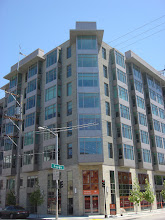
Our second "new kid" is 77 Van Ness. I have to be honest that I was not expecting much from this development. Located on super-busy Van Ness Avenue directly across the street from depressing, soviet inspired buildings, I thought I was entering the condominium version of Siberia. I could not have been more wrong.
The eight story building is actually five floors and 50 units of residential sitting above three floors of commercial office and ground floor retail. A subtle and tasteful lobby and elevator bank are shared by both. Parking is provided via Klaus lifts for all units and it is included in the price.
The exterior does a good job blending in with the neighbors (Masonic Hall and a San Francisco School Board building) and there are alleys on both sides giving the building plenty of light and air.
Floor plans, finishes, views and square footage are all exemplary. My only quibble being that the interior doors are a traditional two-panel style which clashes slightly with the otherwise clean and contemporary aesthetic seen everywhere else.
The neighborhood may be considered Civic Center but I predict that the future residents of 77 Van Ness will be spending most of their free time in Hayes Valley; conveniently located two blocks west.
Studios start at $360K, one-bedrooms at $443K and two-bedrooms at $641K. Given the overall quality of this building, I'd say these are some of the best values I've ever seen in San Francisco.
My favorite aspect of both buildings ? They are known by their address only and have eschewed a "name". These kids are very 2009.
To schedule a tour of one or both of these new-to-the-market developments please call or email me.
Tuesday, May 26, 2009
Taking a Walk on the Mild Side, New York City Begins Bold Planning Experiment in Times & Herald Squares. A Model for Downtown San Francisco ?
Ask anybody who lives in an urban environment if they ever had a close call with a car or truck while attempting to walk across the street and chances are they will have more than one anecdote. Unfortunately, most of us have accepted that being a pedestrian in San Francisco comes with the added thrill of taking your life in your hands once you step off the curb.
Drivers aren't the only culprits. Every week I see people stepping into the street engrossed in their mobile phones without a single glance toward oncoming traffic. It seems they expect the cars, buses and trucks will slow or stop to allow them to cross, unscathed. Never mind that the drivers too, are engrossed in their mobile phones or checking their teeth in the rear-view mirror.
With these scenarios in mind, New York City's Transportation Commissioner completed an ambitious project Sunday that closed two sections of Broadway to vehicles from 47th to 42nd Streets in Times Square and 35th to 33rd Streets in Herald Square. Her goals are twofold: improve traffic flow in these otherwise gridlocked locations by routing traffic to cross streets and the creation of broad pedestrian plazas in two of Manhattans most celebrated and crowded urban gathering places. The plan has its share of critics but it's hard to argue with a scheme that carves public open space out of dense, built- out areas without the loss of public or private property.
Can San Francisco take a cue from The Big Apple by appropriating sections of our streets and giving them back to residents and visitors who will actually use them ? Or is maintaining the full length of Market, Mission, Howard, Folsom, Harrison, Bryant, Brannan and Townsend Streets for SUV's speeding toward the Bay Bridge the best use of these unrecognized resources ?
There have been plans floating around City Hall since the 1960's to close some or all of Market Street (San Francisco's Broadway) to vehicular traffic. Each time a new plan surfaces, it gets shot down by merchant groups claiming that closing the street will hurt their business by impeding the flow of customers and delivery trucks. As one ponders the public transit already in place and the primarily retail and office uses of buildings along Market, it's hard to fathom that this scheme would do anything but draw more people to patronize these businesses.
San Francisco has however, planned for a new and improved Folsom Street Corridor from The Embarcadero to Second Street. The approved plan includes widening sidewalks, planting trees and other traffic calming measures that will take back part of the street for pedestrians. The plan looks good on paper but the reality is that "Folsom Boulevard" as envisioned won't happen for at least another ten years or whenever the new TransBay Terminal, Tower and related construction is complete.
It's not all doom and gloom, though, for those who can envision Downtown transformed into a safer, more human-focused environment. When the various neighborhood farmers' markets and street fairs take place, we get a short taste of what life could be like when parts of our busy streets are closed. Vendors set up shop, people sit, shop, strut, mingle and, for a few hours, a neighborhood becomes a place for it's residents and visitors to savor and experience without noise, fumes and risk.
It sure beats the life-threatening gamble of calculating whether or not that MUNI bus barreling toward you is going to run the red light or not.
Thinking about buying or selling Downtown ? You owe it to yourself to consult an expert. I'm happy to discuss your real estate goals, no obligation.
Thanks for reading; see you next week.
Tuesday, May 12, 2009
Pools, Theaters, Concierges, Oh My ! Downtown Developments Offer Amenity Packages to Lure Buyers, Secure Bragging Rights.
It used to be that when developers were planning a new condominium tower they would include a fitness center, provide a doorman and maybe throw in a pool and they were done. But when the market heated up in the early 2000's, they chose to offer more and more amenities to draw buyers, bolster the building's brand and differentiate from the competition. The flip side of these lavish extras is that they don't come free. For every additional feature, there is the cost to maintain and eventually replace that item-- and that adds to the monthly assessment for each unit in the building.
So is it better to go light on the amenities and reduce the HOA operating expenses, thus reducing the monthly dues ? Or is including even the most esoteric amenity (Olive Oil Steward, perhaps) the way to ensure prestige and future value ?
In post-boom San Francisco, we have three high profile developments that chose unique strategies when it comes to the dog park-guest suite-pilates studio selection process. Let's ponder their merits, shall we ?
BLU
At 112 units, BLU is the smallest community we will be comparing and its size is probably the primary reason the development team chose to go light on the extras. There is a 24 hour doorman stationed in the stylish lobby, a lovely landscaped terrace in the back with a barbecue and catering kitchen and... that's it. While some may squawk at the paucity of amenities, I think it was a smart move. The dues for these 2-bedroom homes average about $625 per month making them the lowest of the three buildings in our comparison. Less equipment to maintain, less energy consumed, less that can go wrong. BLU is the stylish yet sensible lady at the party whose "less is more" approach allows her to leave the diamonds at home while still offering up enough sizzle to keep the crowd interested.
Infinity
Most of my readers are well versed in The Infinity's amenities package, but here's a recap for the uninitiated: heated indoor lap pool, enormous fitness center, his and hers saunas, pilates studio, doormen in all four lobbies, concierge, screening room, business center, conference room, and club room with caterers kitchen and terrace. This impressive list is but an elevator ride away. That said, it's an awful lot of stuff to maintain, so the dues for a 2-bedroom here average about $760 per month. What makes it work? There are over 700 units in the complex, so it's not an onerous cost per individual unit.
Millennium Tower
Representing the ultimate in condominium amenities, Millennium Tower is as luxe and over-the-top as it gets in Downtown San Francisco. In addition to the gym, pool, business center and everything that Infinity offers, Millennium boasts a private dining room serviced by the on-site restaurant RN74, climate controlled wine storage for every unit and an army of liveried staff to take your shopping bags, valet your car, open the door and push the 'up' button on the elevator. If you want 5 star service 24/7, this is the building for you. The price ? Well, if you have to ask.... I'll tell you. This glamour will run you about $1400 per month for a 2-bedroom.
It seems that there is a building for every taste and budget Downtown. Although paying monthly dues on top of the mortgage and property taxes isn't for everyone, it sure beats cleaning out the gutters and mowing the lawn on weekends.
Subscribe to:
Posts (Atom)


 Posts